
It was a gray November afternoon at Chicago O’Hare International Airport, one of the busiest hubs in the world. Around 4:15 PM on November 7, 2006, a United Airlines ramp employee looked up over Gate C17 on Concourse C and saw something that didn’t belong in any flight plan.
A dark, metallic disc – silent, perfectly still – was hovering below the 1,900-foot cloud ceiling directly above the gate area. Within minutes, word spread across the ramp. Pilots in a cockpit at the gate craned their necks to look. Mechanics stopped what they were doing. A supervisor called the FAA tower.
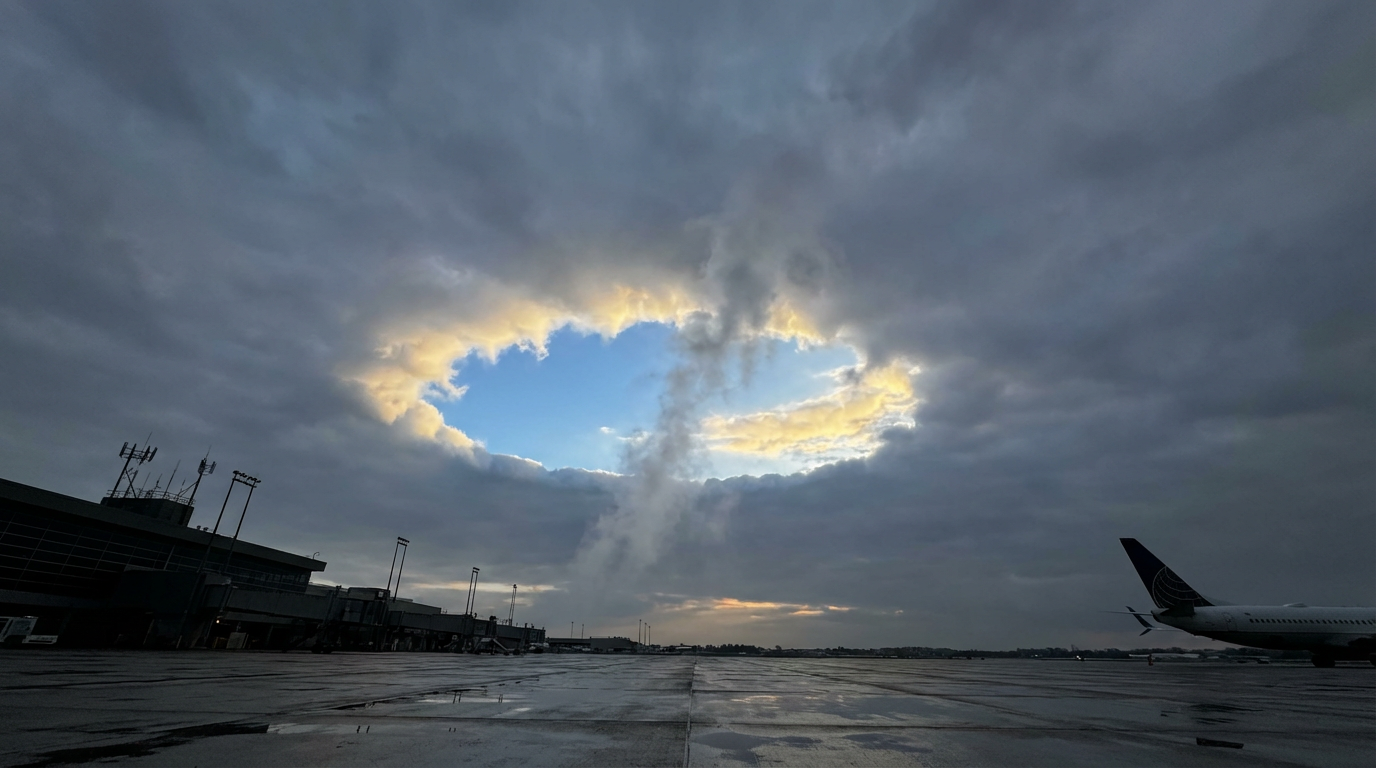
Then the object moved. Witnesses said it tilted slightly and accelerated straight up, piercing the overcast and leaving behind a sharp, circular hole in the clouds – as if someone had punched through a gray ceiling to reveal the sky above. The hole lingered for several minutes before slowly closing.
What the Witnesses Described
About a dozen United Airlines employees – pilots, mechanics, ramp workers, and at least one supervisor – reported seeing the object. Their descriptions were remarkably consistent on the basics: round or disc-shaped, dark gray or metallic, completely silent, hovering motionless below the clouds.
Size estimates clustered around 18 to 30 feet in diameter, though some observers estimated smaller. The first officer of a United Boeing 737-500 parked at Gate C17 described it with his captain from the cockpit:
A stable, perfectly round, silent object with a “dirty aluminum” appearance.
A United mechanic who had been taxiing a Boeing 777 was blunt with reporters. He expressed skepticism about extraterrestrial explanations but insisted the object “definitely was not an [Earth] aircraft.”
Two taxi mechanics caught the moment earlier than most. When the tower later radioed about the report, one of them replied matter-of-factly:
“We thought it was a balloon but we’re not sure."
"Somebody Observed a Flying Disc”
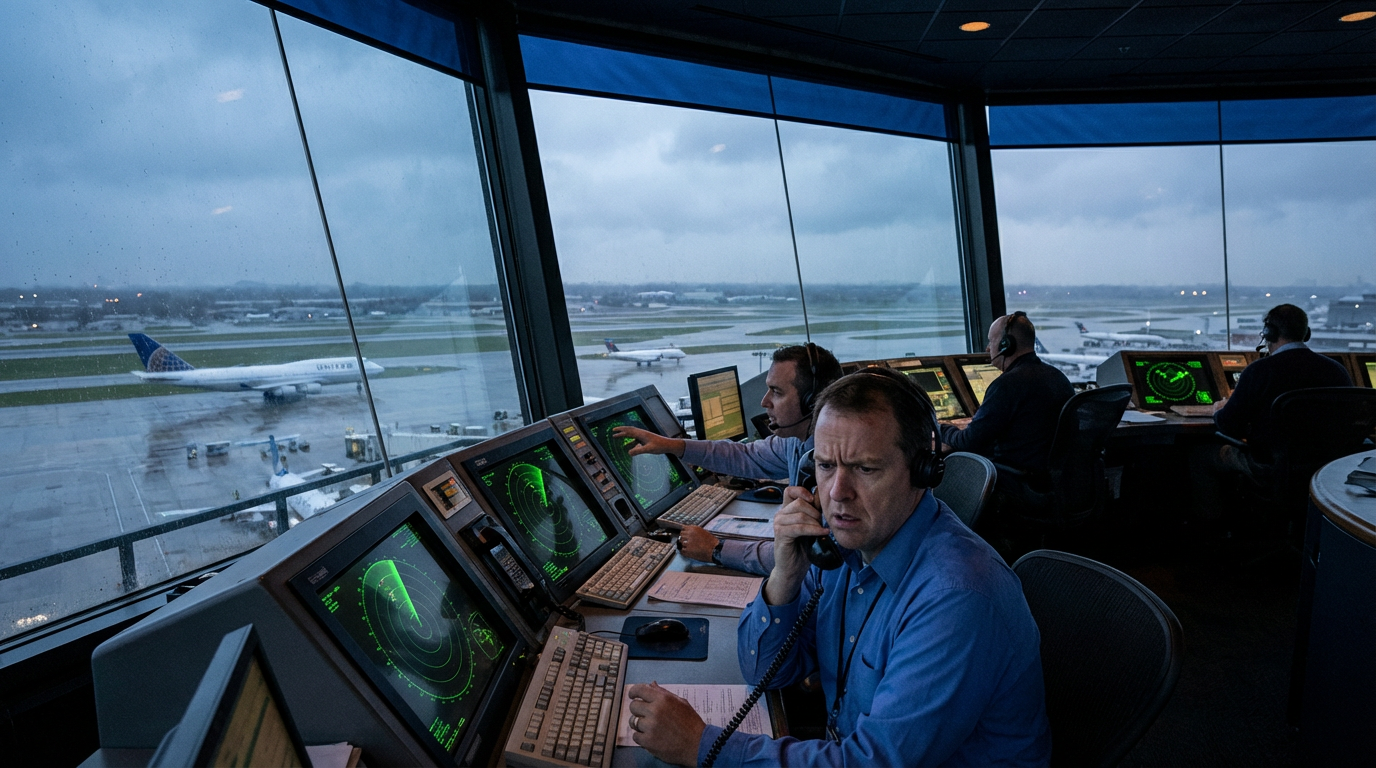
The sighting wasn’t just whispered among ground crew. It made it into the tower. FOIA-released air traffic control recordings – later obtained and published by the National Aviation Reporting Center on Anomalous Phenomena (NARCAP) – captured the moment an inbound ground controller relayed the report:
“They called us… somebody observed a flying disc… above… gate Charley 17.”
A United shift manager notified the TSA and United’s headquarters operations center. But the mood in official channels was not one of urgency. Craig Burzych, an air traffic controller and union official at O’Hare, responded with a joke that became one of the most quoted lines of the case:
“To fly 7 million light years to O’Hare… because your gate was occupied is simply unacceptable.”
The laughter in the tower recordings, NARCAP later argued, was itself evidence of the problem – a culture of stigma that discouraged serious reporting of unidentified objects in controlled airspace.
The Hole in the Sky
The most striking detail – and the one that distinguished this sighting from routine misidentifications – was what the object left behind.
Multiple witnesses described a clearly defined circular opening in the thick overcast right where the disc had entered the cloud layer. The hole was roughly the same size as the object and revealed patches of sky above. It persisted for an estimated five to ten minutes before the clouds drifted back together.
One United employee captured it simply:
“It was like somebody punched a hole in the sky.”
NARCAP’s investigation devoted an entire section to analyzing the cloud-hole phenomenon, examining weather data, witness geometry, and timing. The feature was visible to people across the ramp area and became the detail that made the case hard to dismiss.
The FAA’s Response
Despite multiple aviation professionals reporting an unidentified object in the airspace of one of the nation’s busiest airports, the Federal Aviation Administration declined to investigate.
FAA spokeswoman Elizabeth Isham Cory told the Associated Press:
“Our theory on this is that it was a weather phenomenon.”
She added: “When the lights shine up into the clouds, sometimes you can see funny things.”
The FAA said controllers had not seen the object themselves and that preliminary radar checks found nothing unusual. That was the end of it. No formal inquiry. No safety review. No follow-up with the witnesses.
United Airlines was equally terse. Spokeswoman Megan McCarthy said company officials “do not recall discussing any such incident from Nov. 7.” NARCAP’s reconstruction, however, documented that a company supervisor had instructed the Gate C17 flight crew to push back for their scheduled departure while the object was reportedly still visible overhead.
The Story Breaks
The incident happened in November 2006 but didn’t reach the public until nearly two months later. On January 1, 2007, Chicago Tribune transportation reporter Jon Hilkevitch published the first major account, based on interviews with witnesses who insisted on anonymity.
The story went viral – one of the first UFO reports to do so in the early Web 2.0 era. The Columbia Journalism Review reported that Hilkevitch’s article generated over one million page views on the Tribune’s website, making it the most-read story the paper had published online at that point.
National outlets – CNN, MSNBC, the Associated Press – picked it up within days. The AP wire story, which quoted the FAA’s “weather phenomenon” explanation, ran in hundreds of newspapers. But public interest ran in the opposite direction: readers overwhelmingly treated the witness accounts as credible.
NARCAP’s Investigation
Where the FAA saw nothing worth investigating, NARCAP – a nonprofit focused on unidentified aerial phenomena and aviation safety – saw exactly the kind of case that demanded scrutiny.
Led by Dr. Richard F. Haines, NARCAP filed FOIA requests for tower voice tapes, TRACON logs, and daily records. The resulting Technical Report 10 (Case 18), released in July 2007, ran dozens of pages and organized witness accounts by lettered designations (A through J and beyond).
NARCAP’s key findings:
- The incident posed genuine aviation safety concerns – an unidentified object hovering over an active gate at a major hub
- FOIA transcripts confirmed that real-time reports were made through official channels
- The FAA’s dismissal as “weather” was unsupported by the evidence and inconsistent with witness descriptions
- The joking tone in tower recordings illustrated a culture of stigma that suppressed serious UAP reporting
Sam Maranto, then the Illinois state director for MUFON, summarized why the case stood out:
“The O’Hare case is one of the best because the witnesses are trained observers.”
Why O’Hare Still Matters
The 2006 O’Hare sighting remains one of the most significant civilian aviation UAP cases on record. The witnesses weren’t casual bystanders – they were pilots, mechanics, and ramp professionals working at the gate where the object appeared. FOIA-released communications prove the sighting was reported in real time through official channels. And NARCAP’s detailed technical report provides a level of documentation that most civilian cases lack.
The FAA’s refusal to investigate – at a post-9/11 major airport, in controlled airspace, with multiple professional witnesses – is frequently cited as a case study in institutional failure. It demonstrated a gap between the agency’s safety mandate and its willingness to act when the subject involved was unidentified and didn’t appear on radar.
The case also prefigured dynamics that would become central to the UAP conversation years later: the reporting stigma among pilots and military personnel, the institutional reflexes to dismiss rather than document, and the role of FOIA in forcing transparency where official channels failed. When Congress began legislating UAP reporting protections in the FY2026 NDAA, cases like O’Hare were part of the reason why.
Something hovered over Gate C17 that November afternoon. A dozen trained aviation professionals saw it. The tower was told. The FAA looked away.
The hole in the clouds eventually closed. The questions never did.
| Date | Event |
|---|---|
| November 7, 2006 | United employees report disc-shaped object hovering over Gate C17 at ~4:15 PM CST |
| November 7, 2006 | United supervisor calls FAA tower; TSA and United HQ notified |
| December 7, 2006 | NUFORC posts earliest witness report |
| January 1, 2007 | Jon Hilkevitch’s Chicago Tribune story breaks the case publicly |
| January 2, 2007 | FAA calls it a “weather phenomenon” and declines to investigate |
| January 5, 2007 | Columbia Journalism Review reports Tribune story drew 1M+ page views |
| July 24, 2007 | NARCAP releases Technical Report 10 documenting the incident |
Sources: NARCAP Technical Report 10 (Case 18) · CBS News / AP · The Spokesman-Review / AP · Columbia Journalism Review · Chicago Magazine · Chicago Tribune (Jan 1, 2007) · Chicago Tribune (Jan 8, 2007) · NARCAP Technical Reports