
It was a clear afternoon on June 24, 1947. Kenneth Arnold, an Idaho businessman and experienced private pilot with over 4,000 flight hours, was flying his CallAir A-2 from Chehalis to Yakima, Washington. He’d taken a detour around Mount Rainier to search for a downed Marine Corps C-46 transport – there was a $5,000 reward.
Then a bright flash lit up his cockpit.
“It was a beautiful day. Just as clear as a bell.”
Arnold scanned the sky. He thought it might be sunlight reflecting off another aircraft. Then it happened again.
“But the flash happened again, and that’s when I saw where it was coming from. It came spasmodically from a chain of nine circular-type aircraft way up from the vicinity of Mount Rainier.”
What followed was a two-to-three-minute observation that would reshape how the world talked about unidentified objects in the sky.
What Arnold Described
The nine objects flew in a diagonal, stepped-down chain formation along the Cascade crest. They moved with a weaving, undulating motion – flipping or rocking periodically, which caused intense mirror-like flashes in the afternoon sun. Arnold later compared the movement to “a saucer if you skip it across the water.”
“I could not find any tails on these things. They didn’t leave a jet trail behind them. I judged their size to be at least 100 feet in widespan. I thought it was a new type of missile.”
Arnold used Mount Rainier and Mount Adams as fixed reference points, timing the objects’ passage between the two peaks with his cockpit sweep clock at one minute and 42 seconds. That put their speed at roughly 1,700 miles per hour – far beyond any known aircraft of the era.
“That figured out to something like 1,760 miles an hour, which I could hardly believe. I knew that figure couldn’t be entirely accurate, but I’d say it was within a couple of hundred miles accurate.”
He described the objects as “circular-type” and “saucer-like,” with at least one appearing crescent-shaped. They were bright, reflective, and completely silent at his altitude of roughly 9,200 feet. After passing Mount Adams, they vanished from view toward Oregon.
How “Flying Saucer” Was Born
Arnold landed in Yakima and told other pilots what he’d seen. The next day, June 25, he stopped in Pendleton, Oregon, and spoke with Bill Bequette, a reporter at the East Oregonian, and editor Nolan Skiff. The paper ran a short front-page item describing “nine saucer-like aircraft flying in formation.”
The story went out on the Associated Press wire. By June 26, headlines across the country had transformed Arnold’s motion analogy into a shape description. A Chicago Sun headline – “Supersonic Flying Saucers Sighted by Idaho Pilot” – is widely cited as one of the earliest prominent uses of the phrase “flying saucer” in print.
Arnold later pushed back on the mischaracterization. In a 1950 interview with Edward R. Murrow, he made the distinction explicit:
“They said that I said that they were saucer-like; I said that they flew in a saucer-like fashion.”
It didn’t matter. The term had already taken hold. The East Oregonian itself, per a 2017 retrospective, never actually used the phrase “flying saucer” – but the wire service rewrite and headline writers across the country had done the work for them.
The Wave That Followed
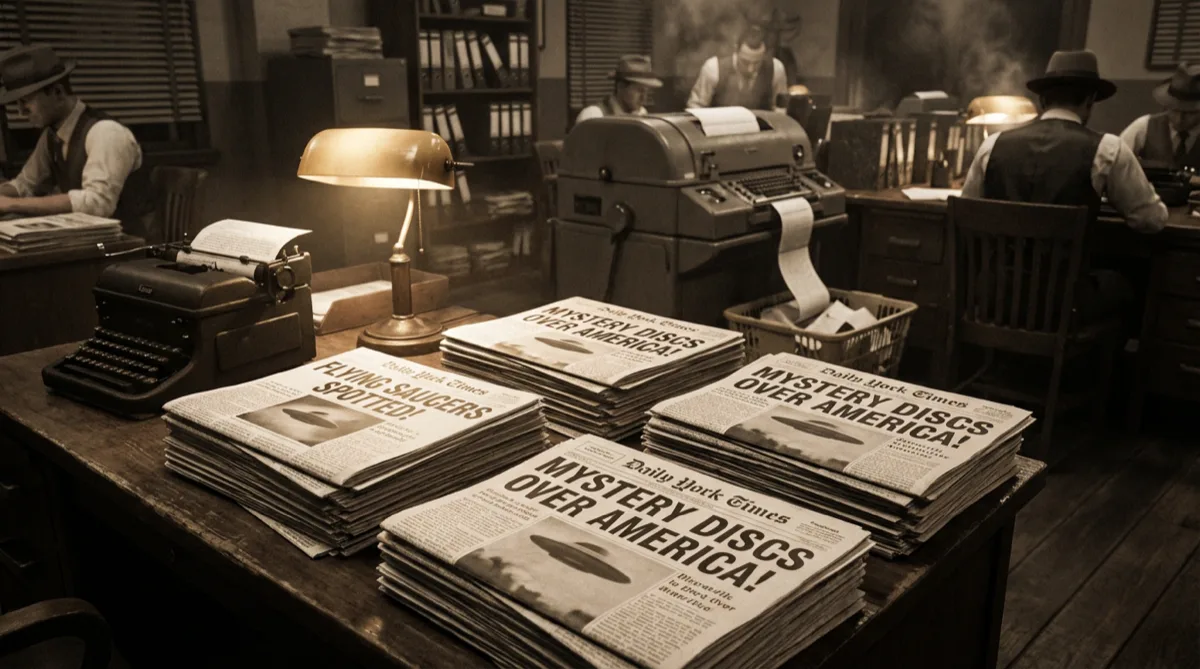
Arnold’s report didn’t just make news – it opened a floodgate. In the weeks that followed, hundreds of additional “flying disc” reports poured in from across the United States. Retrospective Air Force histories cite up to 850 additional reports in the weeks after Arnold’s sighting.
Among the most notable:
| Date | Event |
|---|---|
| June 24, 1947 | Kenneth Arnold reports nine objects near Mount Rainier |
| June 25, 1947 | East Oregonian publishes first account; AP wire picks it up |
| June 26, 1947 | National headlines spread; “flying saucer” enters the lexicon |
| July 4, 1947 | United Airlines crew reports disc-like objects over Idaho |
| July 8–9, 1947 | Roswell Army Airfield issues and retracts “flying disc” press release |
The Roswell incident – now the most famous UFO case in history – came just two weeks after Arnold, and the “flying disc” framing in Roswell was amplified by the already-circulating “flying saucer” narrative Arnold had inadvertently created.
The Government Responds
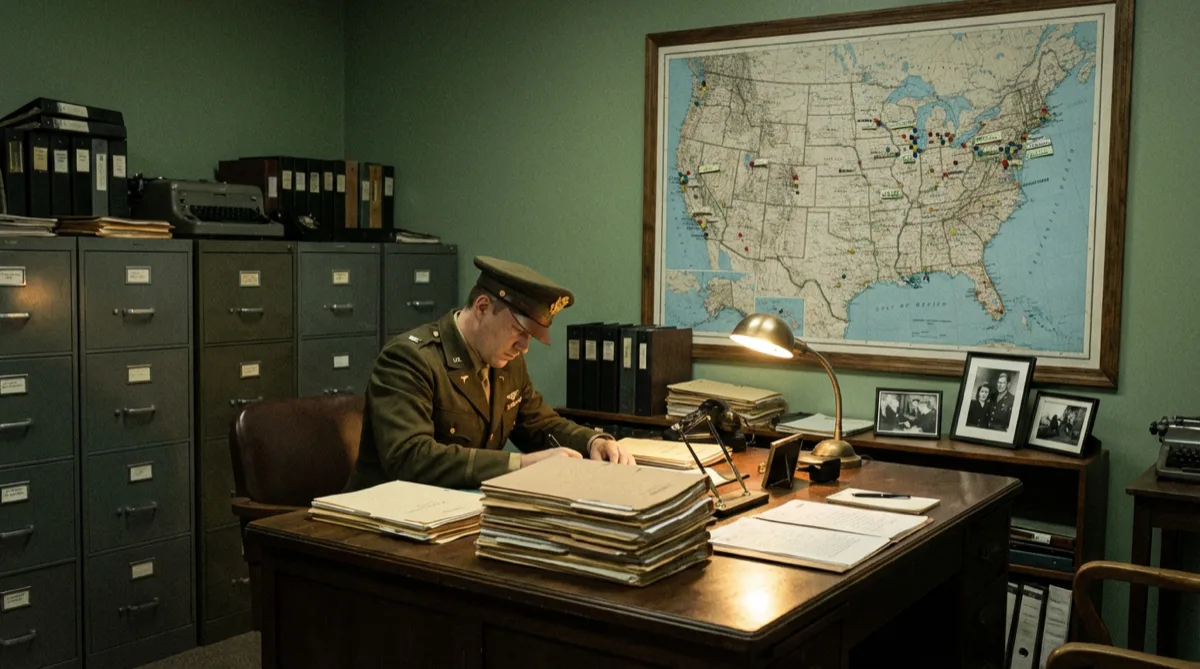
The military took notice. Army Air Forces intelligence began evaluating the best reports from the summer 1947 wave, with Arnold’s case serving as a reference point.
A declassified Air Force Materiel Command assessment was blunt:
“The report cannot bear even superficial examination, therefore, must be disregarded.”
Another Air Force document reached for a natural explanation:
“It is the Air Force conclusion that the objects of this sighting were due to a mirage.”
But the reports kept coming, and dismissal gave way to formal investigation. In January 1948, the Air Force established Project SIGN – its first official UFO study program. SIGN was renamed Project GRUDGE in February 1949, which was itself terminated in December 1949. In March 1952, the most famous of the programs launched: Project BLUE BOOK, which would run for nearly two decades and investigate over 12,000 reports.
The chain from Arnold’s sighting to formal government UAP investigation programs stretches across nearly eight decades – and the questions raised in that cockpit over Mount Rainier still echo in congressional hearing rooms today.
A Phrase That Outlived the Sighting
Kenneth Arnold didn’t invent the UFO phenomenon. People had been seeing unexplained things in the sky for centuries. But his report – filtered through wire services and headline writers – gave the world a label that stuck. “Flying saucer” shaped how millions of people imagined, reported, and debated unidentified aerial objects for the next 80 years.
The irony Arnold carried for the rest of his life was that the label never matched what he actually said. He described how they moved, not what they looked like. The newspapers got it wrong. The public ran with it. And the phrase outlived every attempt to correct it.
Sources: Associated Press · East Oregonian · The Atlantic · HistoryLink.org · Air & Space Forces Magazine · OSU Origins · AARO Historical Record Report Vol. 1 (PDF) · Skeptical Inquirer · CUFOS IUR (PDF) · FBI Vault – UFO