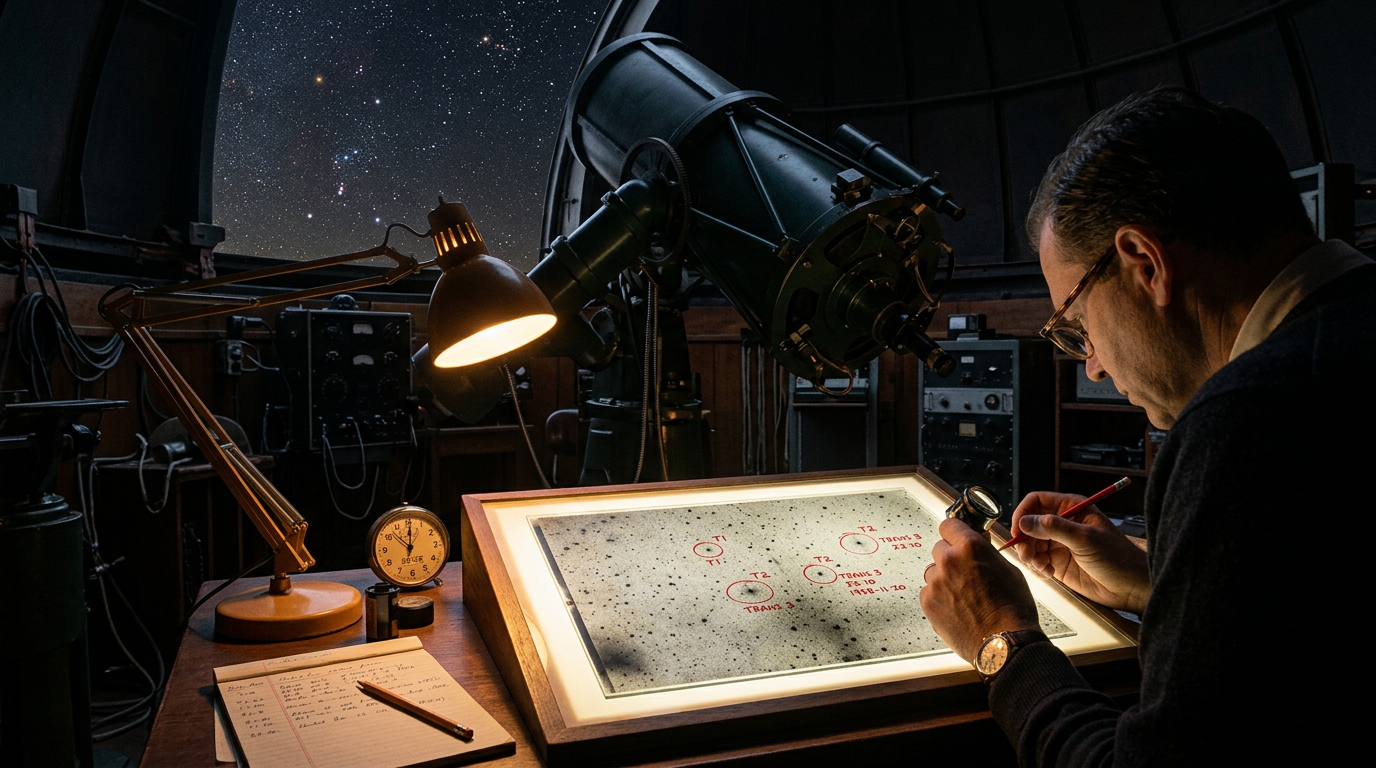
On March 20, 2026, a researcher at the Space Telescope Science Institute quietly posted a preprint to arXiv. The paper described an analysis of photographic plates taken in the mid-1950s at Hamburg Observatory in Germany. What he found on those plates – mysterious flashes of light that appear and vanish within seconds, behaving like reflections from flat objects in orbit – matched findings from an entirely separate research project using different plates from a different observatory on a different continent.
The problem is straightforward: nothing was supposed to be in orbit in the mid-1950s. Sputnik, the first known artificial satellite, did not launch until October 4, 1957.
The paper is preliminary. The analysis is ongoing. But the confirmation is independent, and the data now comes from two separate archives. Whatever left those marks on the plates was real, it was brief, and it was overhead.
The VASCO Project
The story begins with Beatriz Villarroel, an astronomer affiliated with the Nordic Institute for Theoretical Physics (Nordita) in Stockholm and the Instituto de Astrofísica de Canarias.
In 2020, Villarroel and her team launched the VASCO Project – Vanishing and Appearing Sources during a Century of Observations. The concept is simple: compare old sky survey images with modern ones and look for objects that were there once but are gone now. Or objects that appeared briefly and were never seen again.
VASCO’s primary dataset is the Palomar Observatory Sky Survey (POSS-I), a landmark photographic atlas of the northern sky captured between 1949 and 1958 using the 48-inch Samuel Oschin Schmidt telescope at Palomar Mountain in California. The plates were digitized and cross-referenced against modern catalogs like Pan-STARRS.
“In the citizen science project, we compare images from the 1950s with modern images of the sky. The ultimate goal is to identify an object that is clearly visible in several old images, but no longer visible today.” – Beatriz Villarroel, email to Space.com, 2022
The first VASCO paper, published in The Astronomical Journal in 2020, identified roughly 100 red-band point sources visible in one epoch but absent in modern surveys. But it was a 2021 paper in Scientific Reports (Nature Portfolio) that drew the most attention.
Nine Flashes on a Single Plate
On April 12, 1950, a POSS-I red plate captured nine simultaneous transients – brief, bright point sources clustered within roughly 10 arcminutes of each other. They appeared on the plate and nowhere else: not on adjacent temporal exposures, not in deeper modern CCD imaging. They were there for a moment, and then they were gone.
Villarroel’s team systematically ruled out explanations. Plate contamination, cosmic ray hits, and processing artifacts were considered and addressed. What remained was a scenario the authors described carefully:
“Rotating geosynchronous satellites (or debris) may produce short sub-second glints with the observed amplitudes… One of the key signatures of small metallic objects with flat, reflective surfaces orbiting our Earth in geosynchronous orbits is the presence of multiple, very fast and bright glints within the same field-of-view within a few minutes from each other. The only problem with this scenario is that no satellites are known to have existed prior to the Soviet-made Sputnik in 1957, seven years after the appearance of the transients in the 1950 POSS-I image.”
The implications were clear enough that the paper explicitly framed the findings in the context of SETI – the search for extraterrestrial intelligence.
The Independent Confirmation
This is where Ivo Busko enters the picture. Busko is a senior systems software engineer at the Space Telescope Science Institute (STScI) in Baltimore – the operations center for the Hubble and James Webb space telescopes. His day job is building tools for professional astronomers. His side project, it turns out, is hunting the same anomalies Villarroel found – using completely different data.
Busko’s preprint, posted to arXiv on March 20, 2026, describes a search through plates taken at Hamburg Observatory’s Großer Schmidtspiegel – a 1.2-meter Schmidt camera with optical characteristics similar to the Palomar telescope. The plates date from 1954 to 1957, digitized by the APPLAUSE Archive (Archives of Photographic Plates for Astronomical USE), a German-led effort that has scanned roughly 98,000 plates containing some 4.5 billion extracted sources.
Busko’s methodology is deliberately different from VASCO’s. Rather than cross-referencing plates against modern catalogs, he analyzes pairs of plates taken in rapid sequence – roughly 30 minutes apart – of the same sky regions. Objects present on the first plate but absent on the second are flagged as transient candidates. From 41 plates analyzed so far, Busko identified 70 candidates; visual vetting reduced that to 35 good candidates.
 Figure 2 from Busko (2026): A transient candidate on plate pair 9319–9320, December 3, 1956. Top left: the transient is clearly visible. Top right: 30 minutes later, it is gone. Bottom right: its radial profile (red) is narrower than surrounding field stars (blue).
The key finding is in the physics of the flashes themselves:
“While the analysis is ongoing, one notable result is that our findings independently confirm that these transients exhibit systematically narrow full width at half maximum (FWHM) compared to stellar point spread functions. This provides further support for their interpretation as sub-second optical flashes, consistent with reflections from flat, rotating objects in orbit around Earth.” – Ivo Busko, arXiv:2603.20407
In plain language: the flashes are sharper than stars. On a long-exposure photographic plate, real stars blur slightly due to atmospheric seeing and telescope tracking errors. A sub-second flash – something that lights up and fades in less than a heartbeat – would not accumulate that blur. It would appear as a tight, narrow point. That is exactly what both VASCO and Busko are seeing.
Why This Matters
Two independent teams. Two different observatories (Palomar in California, Hamburg in Germany). Two different archives. Two different methodologies. The same result: unexplained sub-second flashes on 1950s plates, consistent with sunlight reflecting off flat, rotating objects in near-Earth orbit, in an era when no human-made object had yet reached space.
 Figure 1 from Busko (2026): PSF diagnostics for plate pair 9319–9320. Red dots (unmatched transients) cluster at lower FWHM than matched stars (black/blue), consistent with sub-second flash duration.
The VASCO team has pursued this line further. A 2025 paper in Publications of the Astronomical Society of the Pacific searched for aligned transients – multiple flashes that fall along a straight line on a single plate, as would be expected from a tumbling reflective object moving across the field of view during a long exposure. The opening line of that paper stated it plainly:
“Old, digitized astronomical images taken before the human spacefaring age offer a rare glimpse of the sky before the era of artificial satellites. In this paper, we present the first optical searches for artificial objects with high specular reflections near the Earth.”
The Mellon Connection

Former Deputy Assistant Secretary of Defense for Intelligence
View full profile →One detail that connects this research directly to the UAP disclosure world: Christopher K. Mellon – former Deputy Assistant Secretary of Defense for Intelligence, the man who hand-delivered Navy UAP videos to the New York Times, and now chairman of the UAP Disclosure Fund – is a named co-author on the peer-reviewed VASCO citizen science paper published in Universe (MDPI) in October 2022.
Mellon’s inclusion on the author list is not ceremonial. The VASCO citizen science project actively recruits volunteers to examine plate images, and Mellon has publicly supported research into pre-Sputnik anomalies as part of the broader question of non-human technology. His presence on a peer-reviewed astrophysics paper – alongside professional astronomers from Stockholm, the Canary Islands, and Algeria – underscores that the boundary between mainstream science and UAP inquiry is thinner than most people assume.
What’s Next
Busko has analyzed only a small fraction of the available Hamburg plates. Future work will expand the dataset to include plates from additional telescopes within the APPLAUSE Archive. The ultimate goal is to cross-correlate his findings with transients already identified by VASCO – building a unified database of unexplained pre-Sputnik orbital events.
Villarroel’s team, meanwhile, continues to refine their search for aligned transients – the telltale signature of a tumbling object crossing a telescope’s field of view. Their SETI framing remains deliberate. As co-author Jamal Mimouni of the University of Constantine told Space.com:
“It may be said to be another twist to SETI. We are also interested in searching for ET artifacts in orbit around the Earth, by looking for fast solar reflections (glints) from satellites and space debris in pre-Sputnik images.”
The plates are 70 years old. The flashes lasted less than a second. But the data is still there, preserved in silver halide, waiting to be read.
Sources
- Busko, I. – “Searching for Fast Astronomical Transients in Archival Photographic Plates” (arXiv:2603.20407, March 2026)
- Villarroel, B. et al. – “Exploring nine simultaneously occurring transients on April 12th 1950” (Scientific Reports, June 2021)
- Villarroel, B. et al. – “The VASCO Project. I. USNO Objects Missing in Modern Sky Surveys” (The Astronomical Journal, 2020)
- Villarroel, B. et al. – “Aligned, Multiple-transient Events in the First Palomar Sky Survey” (PASP, 2025)
- Villarroel, B. et al. – “Launching the VASCO Citizen Science Project” (Universe / MDPI, 2022)
- Space.com – “‘Vanishing stars’ citizen-science project opens the skies to the public” (December 2022)
- APPLAUSE Archive – plate-archive.org