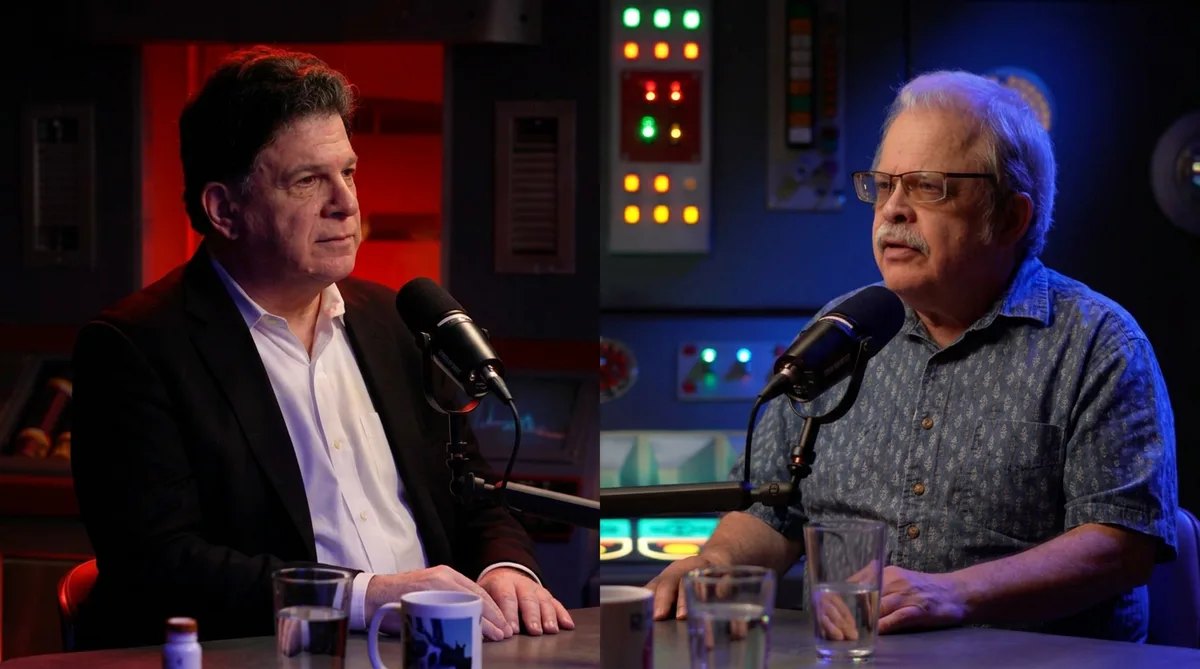
On March 8, 2026, Jesse Michels released what may be the most technically rigorous conversation in the history of UFO media. On his American Alchemy podcast, he sat Eric Weinstein – Harvard math PhD, managing director of Thiel Capital, and one of the sharpest analytical minds to engage with the UFO question – across the table from Dr. Eric W. Davis – astrophysicist, propulsion researcher, and one of the few scientists who claims direct knowledge of an American crash-retrieval program.

The result was four hours of something rare: a genuine intellectual confrontation. Not hostile, not performative – but relentless. Weinstein came with the tools of a theoretical physicist and the instincts of a mathematician. Davis came with decades of claimed insider access. By the end, Weinstein had surfaced a problem that may be more consequential than any single piece of UFO evidence: if the United States really has recovered craft that defy the laws of physics, why has it never put a theoretical physicist on the job?
The Setup

Davis’s credentials are real and documented. He is listed as a principal researcher at EarthTech International and as a senior program engineer at The Aerospace Corporation. His research areas include advanced propulsion, directed energy, and astrophysics. He worked at the National Institute for Discovery Science (NIDS), the private research organization founded by Robert Bigelow, starting in 1996. He later worked at Air Force Research Laboratory and spent fifteen years with physicist Hal Puthoff at EarthTech.
His pathway into the UFO question, as he described it to Michels, ran through NIDS, AFRL, the DIA’s AAWSAP program (formally established in 2009 with $22 million in appropriated funding), the later effort informally called AATIP, and the UAP Task Force led by Jay Stratton starting in 2020. These programs are documented. The AARO historical report confirms the basic architecture Davis described, including the DIA contract, the Bigelow Aerospace Advanced Space Studies role, and Senator Harry Reid’s failed attempt to secure Special Access Program protection for the effort.
What is not confirmed by any public source is the conclusion Davis drew from that access.
‘It’s 100%’
Asked by Michels about his conviction level on Roswell, Davis did not hesitate:
“It’s 100%. And it wasn’t in Roswell, New Mexico. It was on the Foster Ranch in Corona, New Mexico.”
He went further. He said he had used his security clearances, his DIA authorization, and his program access to reach people at a “programmatic level” within the crash-retrieval effort, and that they confirmed “all of that was real, that all of it happened.”
This is Davis’s most direct public statement on the subject. It is also directly at odds with the standing official record. The USAF’s 1994 and 1997 Roswell reports attributed the debris to a Project Mogul balloon array. AARO’s 2024 historical review found no evidence of alien life, recovered extraterrestrial technology, or hidden reverse-engineering programs in the decades of records it examined.
Davis knows this. He disagrees. And that disagreement – between a credentialed insider and the official record – is precisely what makes the conversation worth documenting.
The Missing Physicists
This is where Weinstein changed the conversation.
Davis confirmed that David Grusch’s approximately 40 firsthand witnesses – the people whose testimony Grusch brought to the Intelligence Community Inspector General – were engineers and material scientists. Not a single one was a theoretical physicist. Not a single one was an applied physicist at the PhD level.

“Not a single one of these guys were physicists. They had some discipline in engineering – electrical engineers, material scientists, aerospace engineers, aeromechanical, aerothermal, thermal control, fluid mechanics.”
Davis then went further. He described conversations with a now-senior executive at one of the largest legacy aerospace companies – a material scientist who had worked on the crash-retrieval program for roughly two decades after earning his doctorate. Davis asked him directly about the physics:
“I said, ‘So, where are your physicists? What are your theoretical and applied physicists telling you?’ He said, ‘Well, we don’t have any. We never did. We only were allowed to keep it down to roughly a handful of people in the company to work on this and that’s it.’ And it’s limited to engineering.”
Weinstein’s response was immediate and devastating:
“There’s no physics in it. It doesn’t make any sense.”
Beethoven Without Violinists
This is the moment that distinguishes the interview from every other UFO conversation. Weinstein did not argue about whether the program exists. He argued that if it does, it has been catastrophically, almost absurdly, mismanaged.
“It’s like saying we’re having trouble performing Beethoven’s fifth, and we have the finest accountants, optometrists, boxers, and cardio trainers. And you’re like, well, what about violinists and violists and anybody playing the French horn? And it’s like, oh, well, we don’t do that. So, of course, you’re not going to play Beethoven’s fifth. Because you can’t engineer your way out of a science problem.”
The analogy cuts in both directions. If the program is real and it has genuinely excluded physicists from studying craft that allegedly defy the laws of physics, then the program is not a Manhattan Project. It is something closer to institutional malpractice on a civilizational scale.
Davis agreed. He contrasted the alleged crash-retrieval effort directly with the Manhattan Project – which employed thousands across every STEM discipline, led by Oppenheimer at the civilian level and General Leslie Groves at the military level. The crash-retrieval programs, by Davis’s account, are “disjointed groups of people, small numbers of people. They’re not allowed to know about the other people and what they’re doing.”

The Compartmentalization Trap
The explanation Davis offered is structural. These programs, he said, are waived unacknowledged Special Access Programs – the most restricted classification tier the U.S. government operates. Access is controlled by a “bigot list” of named individuals. If you are not on the list, you do not get in. The programs are deliberately distributed across multiple aerospace contractors to maintain plausible deniability.
Weinstein’s counter: the Manhattan Project was also compartmentalized, enormously so. But it was overseen by a small group with universal access. It drew from the full depth of American scientific talent. It had Feynman, Bohr, Fermi, von Neumann, Bethe, Teller.
“This thing is not a Manhattan Project. And you know what the Manhattan Project was? We both do.”
The implication Weinstein left hanging is stark. Either the crash-retrieval story is not true – or the people running it have been trying to reverse-engineer technology beyond the frontier of human physics without the physicists who define that frontier. For decades.
What Weinstein Sees – and Why It Matters
This was Weinstein’s fifth year engaging seriously with the UFO question, a journey he credits to Michels for initiating. His assessment was characteristically honest:
“I was clearly wrong about it. It’s an enormous area. There’s so many people who claim to have had contact with this program in one form or another. I can’t believe that anyone could train an acting troop at Brando levels of sincerity to lie to me like that. On the other hand, I’ve never seen anything like it where I can’t get a single shred of incontrovertible proof.”
He acknowledged the professional cost of engagement: “One of the reasons nobody from my world wants to get involved with it is that it just makes you look foolish from the point of view of a scientist.”
This is the price Weinstein continues to pay for doing what scientists are supposed to do – following questions wherever they lead, regardless of social cost. He is not a believer. He is not a debunker. He is something the UFO conversation has never had enough of: a first-rate analytical mind willing to sit in the discomfort of not knowing, to keep asking questions, and to say clearly when the answers don’t add up. His previous appearance on Piers Morgan Uncensored laid out the broader architecture of his thinking – Epstein, physics, New Mexico, and the national security implications of controlling gravity. This interview with Davis tested that architecture against someone who claims to have been inside the machine.
‘Not One of These Proposals Excites Me’
Perhaps the most revealing exchange came when Davis walked through the propulsion physics he has worked on – wormholes, warp drives, negative energy density. These are real areas of theoretical research, grounded in general relativity and published in peer-reviewed journals. Davis said he believes a wormhole could be created on demand given sufficient negative energy.
Weinstein was unimpressed:
“Not one of these proposals excites me. They’re boring as sin. I’m sorry to say it. You’re talking about people raised on sci-fi who want to be scientific. And by wanting to be scientific, they don’t want to go beyond the two frontier theories that we have.”
This is not dismissiveness. This is a mathematician saying: if the phenomenon is real and the craft do what witnesses describe, then general relativity as currently understood is insufficient. You need new physics. Not the application of existing physics to exotic engineering concepts – new mathematics, new field equations, new theoretical frameworks. And if the program Davis describes has operated for decades without that, then either the phenomenon is not what it appears to be, or the program has been staring at an object it fundamentally cannot comprehend.
The Wilson-Davis Memo
Davis also made what may be his clearest public statement about the Wilson-Davis memo – a set of notes purportedly from a 2002 meeting between Davis and Vice Admiral Thomas Wilson, then-director of the DIA, in which Wilson reportedly described being denied access to a crash-retrieval program run by a defense contractor.
The document exists publicly, having surfaced through the estate of astronaut Edgar Mitchell. Congressional testimony has cited its provenance. But no government body has formally authenticated its contents.
Davis said plainly that the memo is “real, legitimate, and 100% accurate” and indicated a handwritten original exists.
That is a strong public statement from the person named in the document. It does not constitute authentication – but it narrows the possible interpretations. Either Davis is telling the truth about a document bearing his name, or he is publicly vouching for a fabrication about a meeting he says he attended. There is no comfortable middle ground.
The Official Record
None of this changes the current Pentagon position. AARO’s 2024 historical review concluded that it found “no empirical evidence that any UAP sighting has represented extraterrestrial activity” and “no empirical evidence that the U.S. government or private industry has reverse-engineered extraterrestrial technology.” The Associated Press and Reuters both reported the findings at face value.
Davis’s claims are directly at odds with that conclusion. His counter is that the programs he describes sit inside classification structures specifically designed to be invisible to review bodies like AARO.
That is an unfalsifiable claim. And Weinstein knows it. What he brought to this conversation was not credulity – it was a framework for evaluating the internal coherence of the story as told. If the program is real but has no physicists, then the story has a structural defect that no amount of classified access can explain away.
What This Interview Accomplished
The interview did not prove that crash-retrieval programs exist. It did not produce a piece of recovered material or a declassified document. What it did was something more unusual in UFO media: it applied rigorous analytical pressure to the narrative from inside the conversation, in real time, by someone qualified to do it.
Weinstein asked the questions that most interviewers cannot formulate – about the absence of physics, the structural impossibility of progress without it, and the fundamental incoherence of a program that allegedly possesses technology beyond the frontier of human science but has never invited the scientists who define that frontier.
Those questions remain unanswered. And that, more than any single claim Davis made, is the story.
Watch the Full Interview
Sources: YouTube – Eric Weinstein Demands UFO Secrets From Pentagon Scientist · Apple Podcasts · AARO Historical Report Vol. 1 (2024) · AP – Pentagon study finds no sign of alien life · Reuters – Pentagon UFO report · Grusch Opening Statement (House Oversight, July 2023) · Wilson-Davis Notes (DocumentCloud) · ORNL Analysis Synopsis (AARO) · EarthTech – Principal Team · SPIE – Dr. Eric W. Davis
