
On the evening of November 29, 1989, gendarmes Hubert von Montigny and Heinrich Nicoll were patrolling near the German border outside Eupen, Belgium, when they spotted something hovering roughly 400 feet above a field. It was enormous – a dark, flat-bottomed triangular platform they estimated at 100 feet across, with three blindingly bright white lights at its corners and a pulsing red beacon at the center.
They watched it drift slowly and silently over the Eupen countryside, rotate 180 degrees in place, and continue toward the Gileppe reservoir. Other witnesses in the area reported the same object. By the end of that single night, the Belgian research organization SOBEPS would log 143 separate reports.
It was the first night of what became the largest sustained UFO wave in European history – and one of the few where a NATO air force would publicly confirm it scrambled fighters in response.
The Wave
The sightings concentrated in Wallonia, the French-speaking southern half of Belgium, with the heaviest cluster around the province of Liège. Reports came in practically every day through the winter and into spring 1990. Witnesses described the same basic object: a large triangular craft, silent or nearly so, with three powerful white lights and a central red-orange beacon, moving slowly at low altitude – sometimes hovering – before accelerating sharply and disappearing.
The SOBEPS archive would eventually contain more than 20,000 pages of documents, 400 audio cassettes of phone interviews, and roughly 600 detailed field investigation reports. Later summaries cite totals on the order of 2,000+ reports collected across the broader 1989–1991 period.
Witnesses were not limited to civilians. Gendarmerie patrols across multiple municipalities filed reports. On December 11, 1989, Lt Col André Amond – a Belgian Army staff officer – and his wife reported a close observation near Ernage that was later the subject of a detailed technical reconstruction by a team that included Amond himself, physicist Auguste Meessen, photo analyst Patrick Ferryn, and Belgian Air Staff officer Wilfried De Brouwer.
The Night of March 30, 1990
The wave reached its climax on the night of March 30–31, 1990.
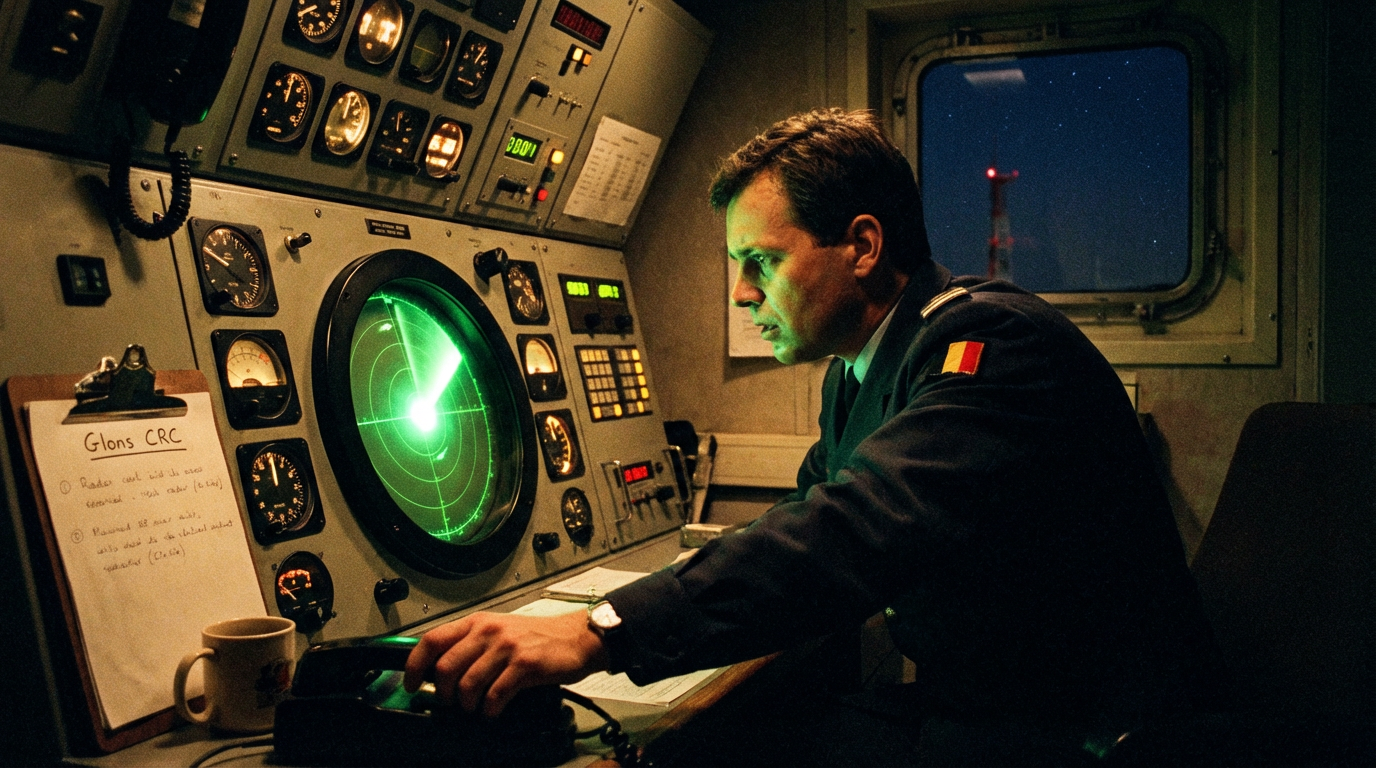
At 11:00 p.m., gendarmerie MDL A. Renkin in Ramillies called the Glons Control Reporting Center (CRC) to report three unusually bright lights arranged in a perfect equilateral triangle, changing colors between red, green, and yellow. Glons radar simultaneously detected an unidentified contact approximately five kilometers north of Beauvechain airfield, moving at roughly 25 knots.
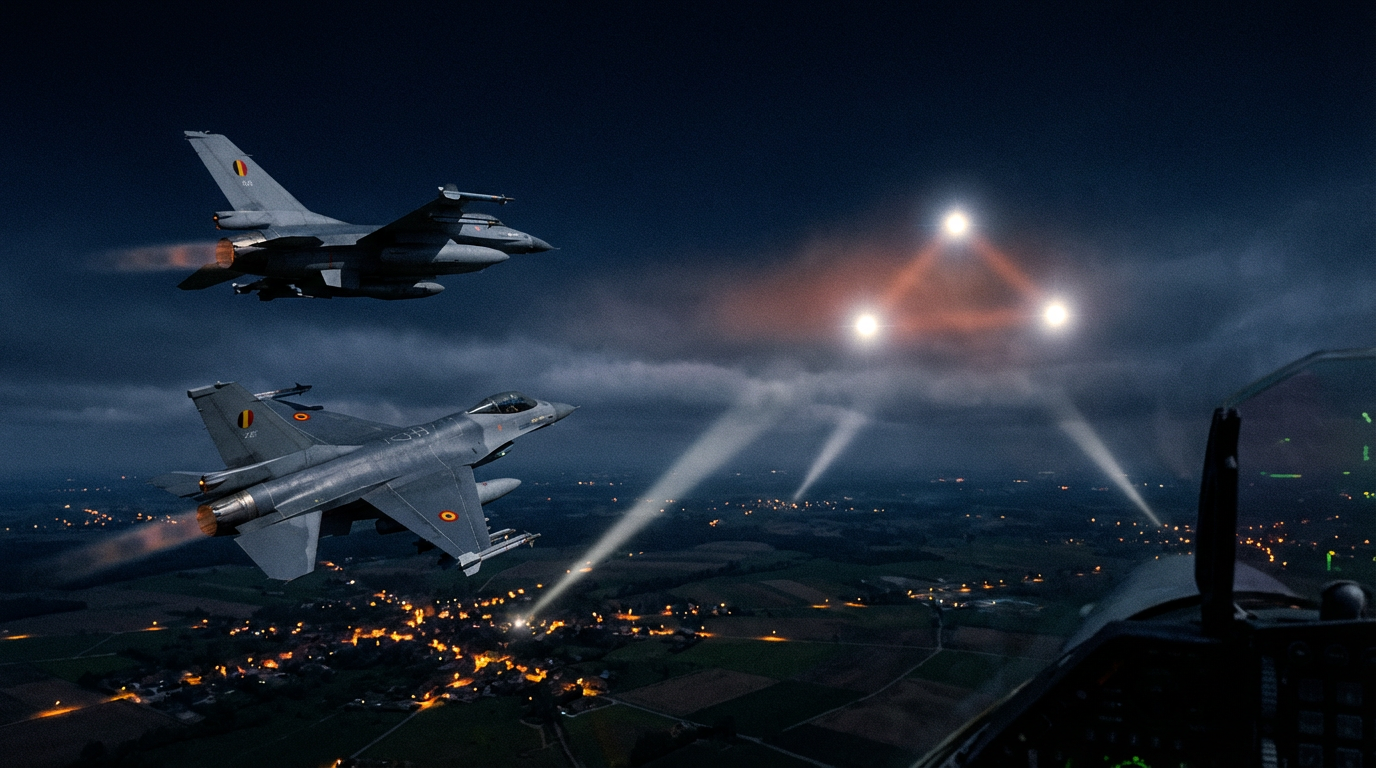
At 11:56 p.m., Glons CRC issued a scramble order. At 00:05 on March 31, two F-16 fighters – call signs AL 17 and AL 23 – launched from the Belgian Air Force’s 1st Wing.
Nine Attempts, Three Lock-Ons
Over the next 49 minutes, the F-16 pilots conducted nine interception attempts. Three times, their onboard radar achieved brief lock-ons – each lasting only seconds before contact was lost.
The data from those lock-ons was extraordinary:
| Lock-On | Time | Details |
|---|---|---|
| First | 00:13 | Target speed shifted from 150 to 970 knots; altitude swung from 9,000 to 5,000 to 11,000 feet, then dropped to ground level; lock broke after seconds |
| Second | 00:30 | Target at ~5,000 ft moving ~740 knots (~850 mph); lock lasted ~6 seconds; a “jamming” indication appeared when lock broke |
| Third | 00:39–00:41 | Target accelerated from ~100 to ~600 knots; lock lost after seconds |
Neither pilot achieved visual contact with the target. Ground radar stations at Glons, Semmerzake, and the Belgian Air Force’s own facilities tracked contacts in the same general area – what Major P. Lambrechts later described in his official report as “unprecedented” multi-sensor correlation.
The Belgian Air Force’s assessment was direct: the objects were not B-2 bombers, F-117 stealth fighters, remotely piloted vehicles, ultralight aircraft, or AWACS planes.
“The presence or the testing of B-2 or F-117 A… can be excluded.”
The event remained officially unexplained.
The Air Force Went Public
On July 11, 1990, Lt Col Wilfried De Brouwer – then Chief of Operations for the Belgian Air Staff – held a press conference. He presented computerized radar printouts from the F-16 onboard systems, walked through the intercept chronology, and summarized the Air Force’s conclusion: they could not identify what their pilots had chased.
“We have nothing to hide in this matter.”
It was an almost unprecedented move. A NATO-member air force was publicly briefing the media on an active UFO investigation, releasing air-defense radar data, and admitting it had no explanation. The Belgian Ministry of Defense had already accepted a request from SOBEPS for cooperation, and the Air Force – along with the gendarmerie, civil aviation authorities, and the Royal Military School – became active participants in the civilian investigation.
The UK Ministry of Defence later included the Belgian case in its own UFO files, noting that NATO radars and F-16 fighters had been involved and that the radar lock-ons remained unexplained.
The Photo That Wasn’t
One piece of evidence became synonymous with the Belgian wave: the Petit-Rechain photograph, supposedly taken in early April 1990, showing a dark triangular craft with bright lights against a night sky. For two decades it was treated as some of the strongest photographic evidence for the triangular craft.
On July 26, 2011, a man identified as Patrick (later named Patrick Maréchal) went on Belgian television station RTL TVi and confessed: the photo was a hoax, made with a painted polystyrene model suspended from a string.
“We managed to trick everyone with a piece of polystyrene.”
The confession was an embarrassment – but it did not address the mass of witness testimony, the gendarmerie reports, or the radar data. COBEPS (the successor to SOBEPS) drew the distinction explicitly: one fraudulent photo does not invalidate thousands of independent observations and a documented military response.
The Investigation
The scientific investigation was led primarily by Auguste Meessen, a physicist at the Université catholique de Louvain, who produced painstaking case-by-case reconstructions – particularly of the November 29, 1989, Eupen observations. Meessen’s analyses addressed and rejected explanations including Venus, meteorological phenomena, and conventional aircraft for the core gendarmerie cases.
SOBEPS published its findings across two major volumes: Vague d’OVNI sur la Belgique – Un dossier exceptionnel (1991) and Une énigme non résolue (1994). The organization’s assessment was careful: many close-range reports showed coherent, repeated features, and conventional explanations offered to date were not fully satisfactory.
Not everyone agreed. In 2008, skeptical researcher Renaud Leclet and colleagues published an analysis arguing that a significant portion of the reports could be attributed to misidentified helicopters and other conventional sources. Meessen published a point-by-point rebuttal.
A Pattern of Triangles
The Belgian wave is one node in a broader, recurring pattern of triangular craft reports:
| Case | Date | Location |
|---|---|---|
| Hudson Valley UFO Wave | 1983–1986 | New York, USA |
| Belgian UFO Wave | 1989–1990 | Belgium |
| Phoenix Lights | March 13, 1997 | Arizona, USA |
| Illinois Triangle | January 5, 2000 | St. Clair County, IL |
Each case shares consistent features: multiple independent witnesses, a large structured craft with bright lights, low altitude and slow speed followed by sudden acceleration, and proximity to military infrastructure. The Belgian case remains the only one where a NATO military formally scrambled interceptors and publicly released the results.
What Remains
More than 35 years later, the Belgian UFO wave endures as a reference case in UAP history. Not because of one photograph – which turned out to be foam and paint – but because of everything else: gendarmerie officers describing a structured craft from 400 feet away; radar operators tracking contacts that outperformed any known aircraft; fighter pilots locking on to targets that accelerated from a crawl to nearly twice the speed of sound and then vanished; and an air force that looked at all of it and said, publicly, that they had no explanation.
The SOBEPS archive still exists, maintained by its successor organization COBEPS. The Belgian Air Force report is still circulating. The radar data still shows what it showed. And no one has come forward to claim the object.
Sources: COBEPS – La vague belge · Meessen (1997) – Étude approfondie · Belgian Air Force Report (Lambrechts) · CUFOS – Belgian Sightings (IUR 1991) · UK National Archives UFO Files · COBEPS – Ernage Report · Reuters – Petit-Rechain Hoax · Leclet et al. – Helicopter Hypothesis