
At 8:16 PM on March 13, 1997, a retired police officer in Paulden, Arizona – a small town north of Prescott – called the National UFO Reporting Center hotline. He’d just watched a cluster of red-orange lights in a tight V formation pass overhead in complete silence.
Within minutes, the phones at NUFORC lit up. A minute later, calls came from Prescott. Then Prescott Valley. Then Dewey. Then Phoenix. Then Tucson. Over the next hour, the same object – or something very much like it – was reported by witnesses spanning nearly 300 miles of Arizona desert, from the Nevada border to the outskirts of Mexico.
By the time the night was over, thousands of people had seen something they couldn’t explain. And then, two hours later, an entirely separate set of lights would make the whole thing even stranger.
Two Events, One Night
The Phoenix Lights are often discussed as a single event, but that framing obscures what actually happened. March 13, 1997 produced two distinct phenomena, separated by roughly an hour.
Event One unfolded between approximately 7:55 and 9:00 PM MST. Witnesses across the state described a massive, structured formation of lights – typically five to seven bright points arranged in a V, chevron, or boomerang shape – moving steadily from north to south. Many witnesses didn’t just see lights: they described a solid object, enormous in scale, that blocked out the stars as it passed overhead. It made no sound.
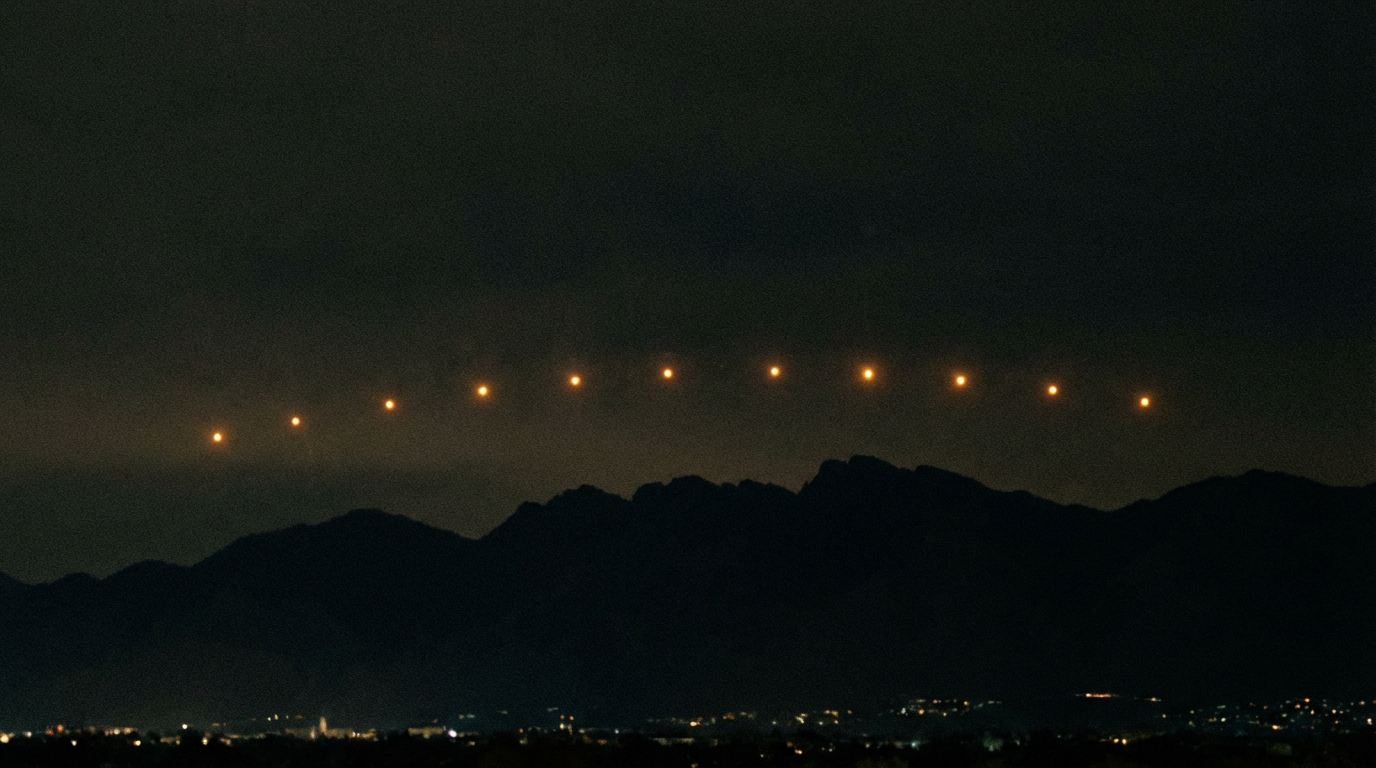
Event Two occurred around 10:00 PM. A row of bright amber lights appeared south and southwest of Phoenix, hovering in a line above the Estrella Mountains. Unlike Event One, this was widely videotaped by residents across the metro area. The lights held position, then slowly descended and “winked out” one by one over the course of 10 to 20 minutes.
The military later attributed Event Two to illumination flares dropped by visiting Maryland Air National Guard A-10 aircraft during a training exercise over the Barry M. Goldwater Range. That explanation fits the timing, location, and behavior of the later lights. But it does not account for what hundreds of witnesses saw an hour earlier – a structured, silent object traversing the length of the state.
Media coverage, then and since, has overwhelmingly focused on the videotaped second event. The earlier overflight – the one without easy answers – received far less attention.
”When It Finally Got Here, We Really Started Getting Antsy”
The witnesses who reported Event One came from every walk of life and described remarkably consistent things.
In Dewey, a group of five adults and teenagers pulled their car over and watched the formation hover directly above them. One member of the group, who had flying experience, estimated the altitude at under 1,000 feet and stressed the total silence – unusual for anything that close and that large.
In Phoenix, Tim Ley and his family watched from their home as a giant V-shaped craft passed directly overhead.
“When it finally got here and we realized this thing was coming right over us, we really started getting antsy.”
Ley described its apparent span as “a couple of blocks.” CNN later worked with the family to produce a computer reconstruction of what they witnessed.
A young mother living about a mile south of Camelback Mountain watched a boomerang-shaped object hover overhead for approximately five minutes. She reported a brief red beam projected forward from the craft before the lights dimmed and it drifted south.
In Tucson, an observer tracked the formation from about 8:45 PM to after 9:00 PM, watching it maneuver overhead for five to ten minutes before departing south.
An amateur astronomer in west Phoenix reported solid, unblinking lights moving north to south and claimed he could resolve each light as possibly two smaller lights. He also reported seeing nearby aircraft turn away.
The Governor’s Two Press Conferences
Three months passed before the Phoenix Lights became national news. On June 18, 1997, USA Today ran the story on its front page. The following day, Arizona Governor Fife Symington held two press conferences.
At the first, he announced he was ordering a state investigation into the March 13 reports.
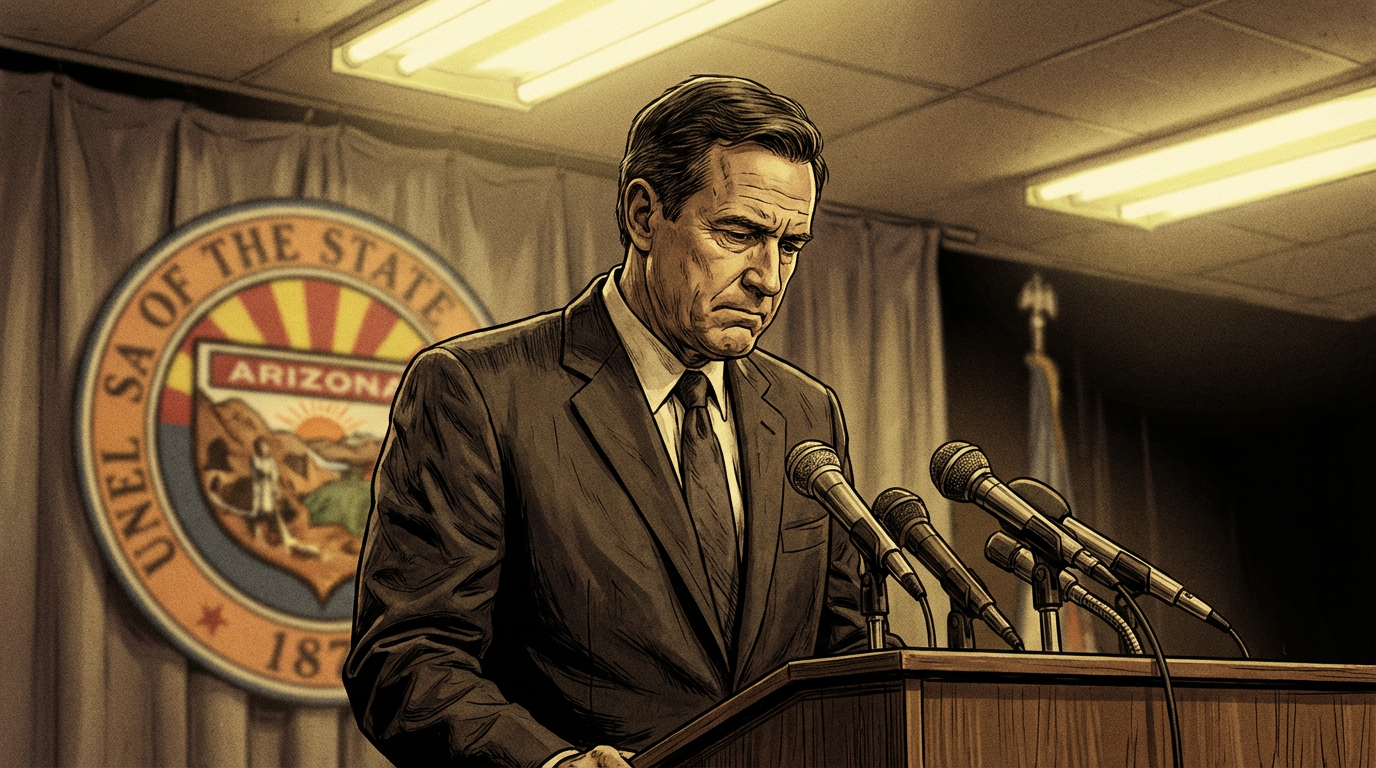
At the second, held hours later, he brought out his chief of staff Jay Heiler dressed in an alien costume and told the assembled reporters:
“This just goes to show you guys are entirely too serious.”
The mockery sent a clear message to the thousands of Arizonans who had reported what they saw. Their governor thought it was a joke.
But Symington wasn’t being entirely honest. A decade later, in March 2007, he told the Associated Press that he had personally witnessed the event – and that what he saw over Squaw Peak that night was anything but a joke.
“Enormous. It just felt otherworldly. In your gut, you could just tell it was otherworldly.”
He said he had stayed quiet to avoid causing public panic. His admission, coming from a former governor and experienced pilot, made international news. It also underscored something witnesses had long argued: the stigma around reporting UAP encounters silences even those in the highest positions of authority.
“I Was Met by a Whole Bunch of Stares”
While Symington was mocking the story, one elected official was taking it seriously.
Frances Emma Barwood, a Phoenix City Council member and Vice Mayor, stood up at a council meeting and asked whether anyone knew what the object was and whether the city could investigate.
“I asked if anybody knew what this object was and could we check into it. I was met by a whole bunch of stares.”
She was warned afterward that she shouldn’t have asked that question. But the calls started coming – not from fellow officials, but from witnesses. Hundreds of them. Over the following weeks and months, Barwood personally spoke with more than 700 people who had seen something on March 13.
The descriptions, she said, were remarkably consistent. And yet no level of government – city, state, or federal – interviewed a single one of those witnesses.
The Flare Explanation
On July 25, 1997, press reports confirmed that visiting Maryland Air National Guard A-10 aircraft had been dropping high-intensity illumination flares over a range southwest of Phoenix on the night of March 13. This became the standard explanation for what people had videotaped.
Richard F. Motzer, an Arizona MUFON field investigator who analyzed multiple videotapes, largely agreed that the later lights were consistent with flares. By comparing footage from different vantage points – some tapes showed six lights, others showed four – he demonstrated that the Estrella Mountain ridgeline was occluding some of the lights depending on camera elevation and position.
“It turned out that the lights were not over Phoenix, but near the Estrella Mountains to the southwest.”
But Motzer was clear about a critical distinction: the flare explanation applied only to Event Two. The earlier V-formation overflight – the event with far more witnesses and far stranger descriptions – was a separate matter entirely. He urged investigators and the public not to conflate the two.
Videographer Mike Krzyston, who captured some of the most widely circulated footage of the later lights, has never accepted the flare explanation for what he recorded.
“If these were flares… How do you drop flares over this distance and they stay in a perfect line?”
What Remains Unexplained
Nearly three decades later, the core mystery of the Phoenix Lights persists. The later stationary lights have a plausible conventional explanation. But the earlier event – a silent, structured formation of lights traversing hundreds of miles of Arizona airspace, witnessed by thousands, described in consistent detail by people who had no contact with one another – has never been officially explained.
No radar data has been publicly released for the earlier time window. The FAA reported nothing unusual. Luke Air Force Base initially claimed it knew nothing and had received no reports, though NUFORC noted phone records appeared to contradict that claim.
The Phoenix Lights remain one of the largest mass UAP sightings in American history. The case is a recurring reference point in government transparency debates and is frequently cited alongside other well-documented incidents like the 1952 Washington, D.C. UFO wave and the USS Nimitz encounter as evidence that certain UAP events resist easy dismissal.
Governor Symington’s arc – from public mockery to private admission – remains one of the starkest illustrations of how stigma shapes official responses to the phenomenon.
Timeline
| Date | Event |
|---|---|
| March 13, 1997, ~8:00 PM | V-formation reported over Henderson, NV; moves south across Arizona |
| March 13, 1997, ~8:16 PM | First NUFORC hotline call from retired police officer in Paulden, AZ |
| March 13, 1997, ~8:17 PM | Multiple reports from Prescott and Prescott Valley |
| March 13, 1997, ~8:30–9:00 PM | Reports from Phoenix metro and Tucson |
| March 13, 1997, ~10:00 PM | Stationary amber lights appear south/southwest of Phoenix; widely videotaped |
| June 18, 1997 | USA Today front-page story breaks the case nationally |
| June 19, 1997 | Gov. Symington orders investigation, then holds mock press conference |
| July 25, 1997 | Military confirms flare exercises southwest of Phoenix on March 13 |
| March 25, 2007 | Symington tells AP he witnessed the craft and calls it “otherworldly” |
Sources: CNN (1997) · Los Angeles Times / AP (1997) · Las Vegas Sun (1997) · NUFORC Preliminary Summary (1997) · MUFON UFO Journal / NICAP (1997) · NUFORC Two-Year Summary (1999) · Deseret News / AP (2007) · ABC News / GMA (2007) · FOX 10 Phoenix (2017) · KGUN 9 (2022) · KJZZ (2015)