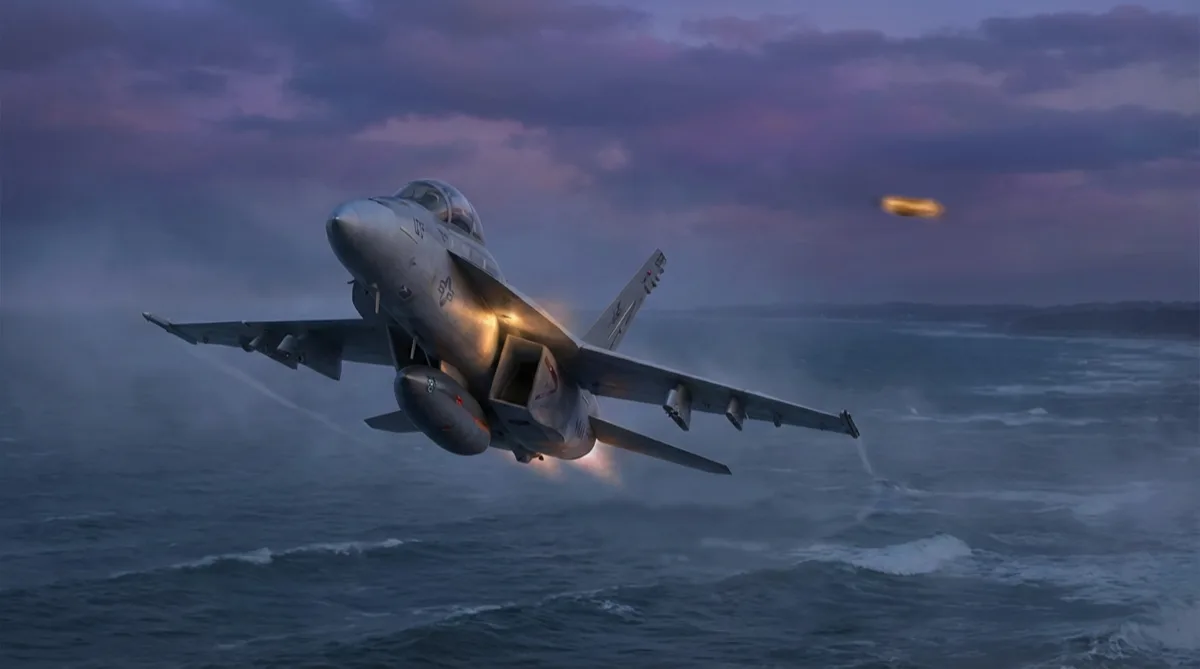
For the better part of a year, Navy fighter pilots training off the coast of Virginia had a problem they couldn’t explain. Their upgraded radars were picking up objects in restricted airspace – objects with no flight plans, no transponders, and no visible means of propulsion. The contacts appeared almost every day.
Then, on January 21, 2015, an F/A-18 Super Hornet’s infrared targeting pod captured two of them on video. Those recordings – known as GIMBAL and GOFAST – would eventually be released by the Pentagon, examined by NASA, debated by Congress, and seen by millions. The objects in them remain officially unidentified.
The East Coast Wave
The encounters began in mid-2014, during routine workups for Carrier Strike Group 12 centered on the USS Theodore Roosevelt (CVN-71) out of NAS Oceana in Virginia Beach. Ryan Graves, an F/A-18F pilot with VFA-11 “Red Rippers”, later attributed the spike in detections to a radar upgrade – the AN/APG-79 AESA system, which gave Super Hornets significantly improved tracking capability.
What the new radar found was unsettling. Unknown contacts were appearing in Warning Area W-72, the restricted training airspace roughly 10 miles east of Virginia Beach, at altitudes and in patterns that didn’t match any known traffic. E-2D Hawkeye airborne early warning aircraft, equipped with the AN/APY-9 radar, picked up similar contacts. The sightings weren’t isolated events – they were routine.
“The sightings were so frequent that they became part of daily briefs.” – Ryan Graves, House Oversight Committee testimony, July 2023
By 2015, a flag-level officer at Fleet Forces Command had received a classified email titled “Urgent safety of flight issue” with one of the infrared clips attached, according to Graves’ testimony. The Navy was aware. The encounters continued.
GIMBAL: “There’s a Whole Fleet of Them”
The first of the two famous clips – GIMBAL – is 34 seconds of ATFLIR infrared footage recorded on January 21, 2015. It shows a distant airborne object tracked by the targeting pod. The object’s heat signature appears as a bright, oblong shape against a darker background, and at one point it appears to rotate.
The cockpit audio is what made the video unforgettable:
“Look at that thing, it’s rotating!”
“There’s a whole fleet of them.”
“They’re all going against the wind – the wind’s 120 knots to the west.”
The pilots weren’t just reacting to one object. Their situational awareness displays showed multiple contacts – a pattern consistent with what Graves and others described as repeated encounters with groups of unknown objects operating in the training area.
GOFAST: Speed or Illusion?
The second clip – GOFAST – was also recorded on January 21, 2015, and runs 34 seconds. It shows the ATFLIR pod locked onto a small, bright object skimming over the ocean. The visual impression is one of extraordinary speed – the object appears to streak across the water with no visible exhaust or propulsion.
But the apparent speed became one of the most analyzed aspects of the entire UAP debate. In 2023, the NASA UAP Independent Study Team used GOFAST as a worked example in their final report, concluding that much of the apparent velocity was a parallax illusion created by the fast-moving sensor platform. NASA estimated the object was at roughly 13,000 feet altitude, moving at approximately 40 mph – a speed consistent with wind drift at that altitude.
The finding didn’t settle the question. It demonstrated that one particular interpretation of the video (extreme speed) was likely wrong, but it didn’t identify what the object was. As the NASA report emphasized, better calibrated data and metadata are needed to draw firm conclusions.
The Cube Inside a Sphere
Not all of the East Coast encounters were captured on video. One of the most striking descriptions came from a near-miss incident at the W-72 entry point – a single GPS coordinate that all aircraft used to enter the training area.
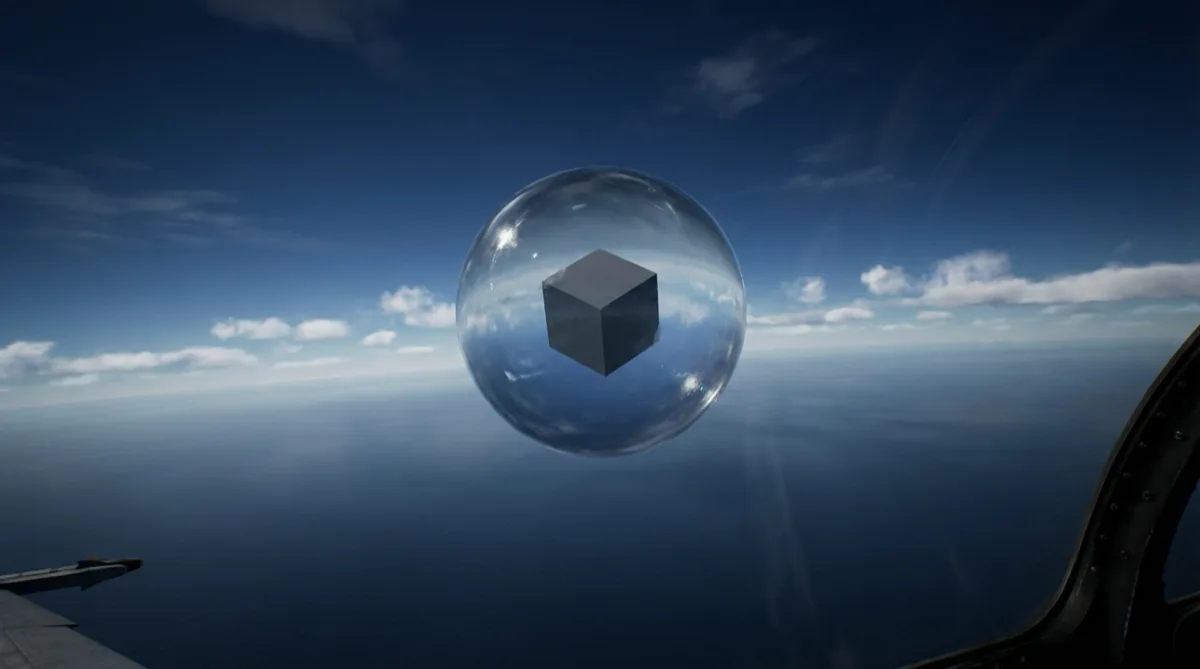
“One of the pilots saw a dark gray cube inside of a clear sphere – motionless against the wind.” – Ryan Graves, House Oversight Committee testimony, July 2023
Two jets flying roughly 100 feet apart took evasive action. A safety report was filed. The object matched no known drone, balloon, or aircraft type in the Navy’s inventory or any publicly known foreign system.
Fellow pilot Danny Accoin, also with VFA-11, corroborated the general pattern in media interviews – radar contacts that couldn’t be visually resolved, objects that appeared as “gauzy blobs” on infrared, and an operational environment where the unknown had become normal.
How the Videos Went Public
The path from classified cockpit footage to worldwide news was neither straightforward nor quick.
The New York Times broke the story on December 16, 2017, in an exposé by Leslie Kean, Ralph Blumenthal, and Helene Cooper that revealed the Advanced Aerospace Threat Identification Program (AATIP) – a Pentagon effort to study UAP. The GIMBAL video was part of that initial wave of coverage.
To The Stars Academy (TTSA), an organization co-founded by former AATIP official Luis Elizondo, publicly released the GOFAST clip in March 2018.
In September 2019, U.S. Navy spokesman Joseph Gradisher took an unprecedented step: he confirmed on the record that the leaked videos depicted “unidentified aerial phenomena” and that the Navy had not authorized their public release.
The Pentagon followed on April 27, 2020, formally releasing all three Navy UAP videos – GIMBAL and GOFAST from 2015, and FLIR1 from the 2004 USS Nimitz encounter – stating:
“The aerial phenomena observed in the videos remain characterized as ‘unidentified.’” – Department of Defense, April 27, 2020
On May 16, 2021, CBS’s 60 Minutes aired a segment featuring Graves describing the encounters. When asked how often the objects appeared:
“Every day. Every day for at least a couple years.” – Ryan Graves, 60 Minutes, May 2021
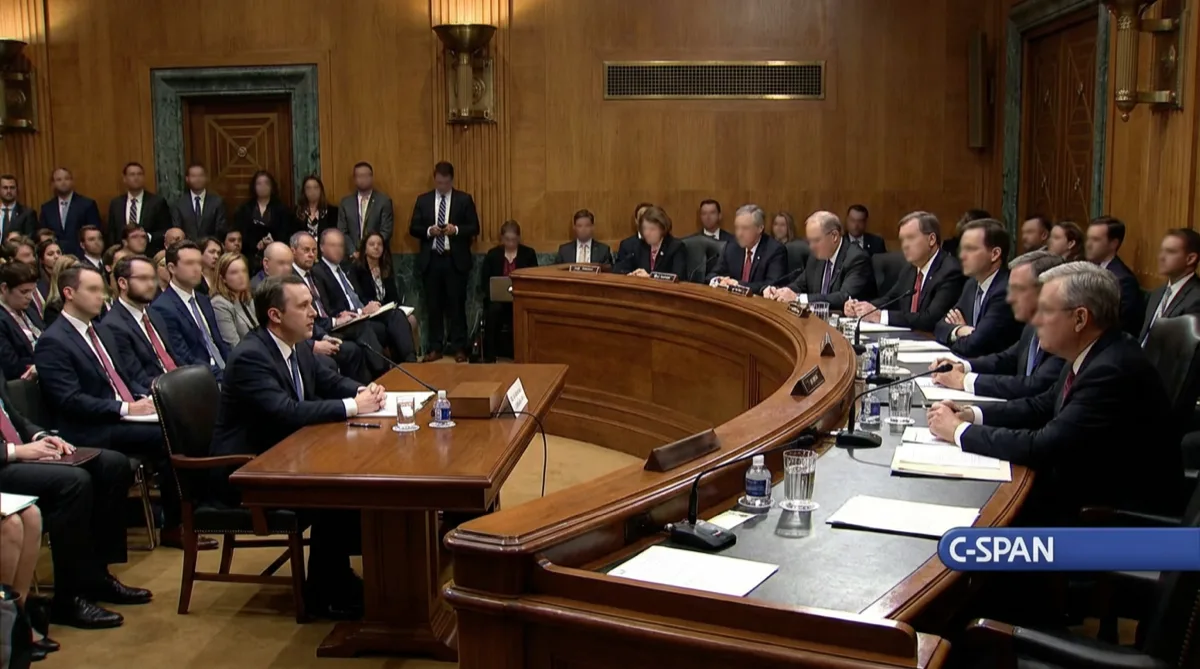
By July 2023, Graves was sitting before the House Oversight Committee, delivering sworn testimony about what he and his squadron experienced. The hearing – which also featured David Grusch’s whistleblower testimony – marked the highest-profile congressional examination of military UAP encounters in decades.
What Remains Unresolved
What makes the Roosevelt-era encounters difficult to dismiss entirely is the same factor that elevates the Nimitz case: multi-sensor corroboration. These weren’t single-witness stories. Airborne AESA radar, shipborne Aegis radar, airborne early warning radar, infrared targeting pods, and direct visual observation all registered something in the same airspace during the same period.
The cube-in-sphere near miss has no satisfying conventional explanation on the public record. The daily frequency of encounters over many months – confirmed by multiple pilots across multiple squadrons – suggests something was persistently operating in restricted military airspace without authorization.
Whether that something was foreign drones, atmospheric phenomena, sensor artifacts, or something genuinely unknown remains an open question. The videos alone can’t answer it. But they ensured the question would finally be asked in public.
| Date | Event |
|---|---|
| Mid-2014 | East Coast UAP encounters begin during CSG-12 workups |
| Jan. 21, 2015 | GIMBAL and GOFAST videos recorded |
| Mar. 11, 2015 | USS Theodore Roosevelt departs Norfolk for deployment |
| Dec. 16, 2017 | New York Times AATIP exposé brings Navy UAP footage to mainstream attention |
| Mar. 9, 2018 | TTSA releases GOFAST video publicly |
| Sep. 18, 2019 | U.S. Navy confirms videos depict “unidentified aerial phenomena” |
| Apr. 27, 2020 | Pentagon formally releases all three Navy UAP videos |
| May 16, 2021 | 60 Minutes airs Ryan Graves interview |
| Jul. 25, 2023 | Graves delivers sworn testimony to House Oversight Committee |
| Sep. 14, 2023 | NASA UAP report uses GOFAST as a parallax case study |
Sources: Ryan Graves House Oversight Testimony (2023) · CBS News / 60 Minutes (2021) · DoD Video Release Statement (2020) · The War Zone – Navy Pilot Reports (2020) · The War Zone – Multiple Squadrons (2019) · AIAA Aerospace America (2019) · NASA UAP Independent Study Team Report (2023) · TIME – Navy Confirms (2019) · Military.com (2019) · RealClearDefense / NYT Reprint (2019) · Metabunk – Gimbal Analysis (2022) · Metabunk – GoFast Analysis (2018)